Tooth Extraction & Oral Surgery: What to Expect | Sedation Dentist Stanmore
Need a tooth extraction or oral surgery? Learn why teeth may need removing, what happens during treatment, how sedation can help nervous patients, and what to expect afterwards.
Being told that you need a tooth removed can understandably make you nervous. Many patients worry about pain, the procedure itself, or what recovery will be like.
The good news is that modern dentistry offers several ways to make tooth removal as comfortable as possible. Depending on the tooth and your individual circumstances, an extraction may be straightforward, or a more involved oral surgery procedure may be required.
For nervous patients or those undergoing more complex treatment, dental sedation may also be an option following an appropriate assessment.
At Centre of Dental Excellence in Stanmore, we provide dental extractions, complex oral surgery and sedation for suitable patients, with treatment planned around individual needs.
Dentists generally aim to preserve natural teeth whenever they can. However, there are situations where extraction may be the safest or most appropriate option.
A tooth may need to be removed because of:
Your dentist will assess whether the tooth can be saved before recommending extraction.
No. The complexity of an extraction depends on the tooth, its position, root shape and the condition of the surrounding bone and gum.
Simple Tooth Extraction
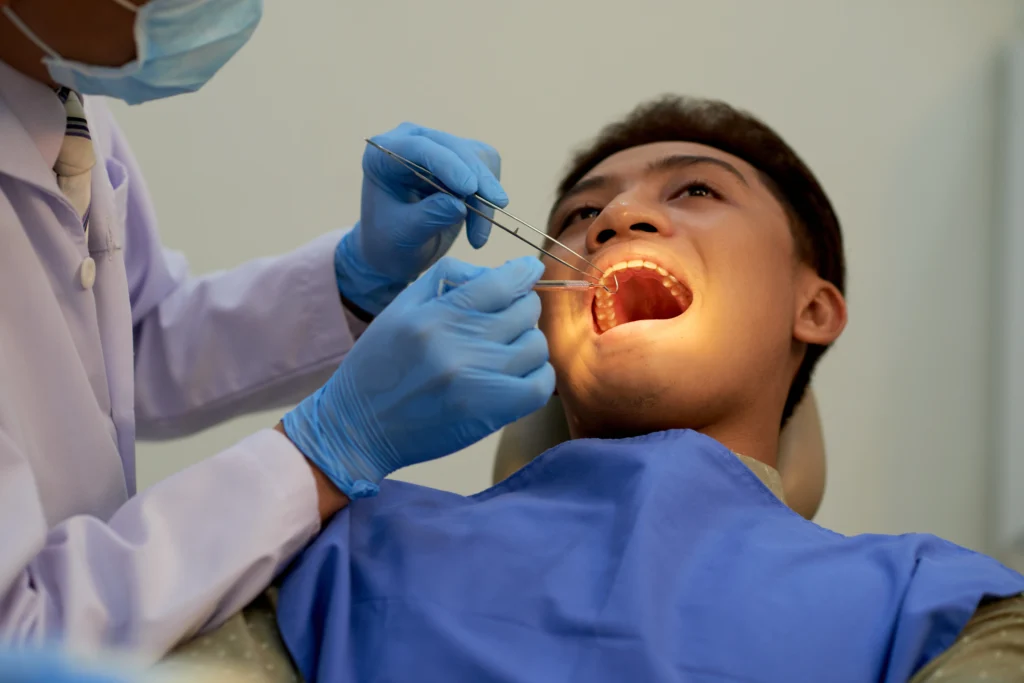
Some teeth can be removed using specialised dental instruments once the area has been numbed with local anaesthetic.
Surgical Tooth Extraction
A more complex extraction may be necessary when a tooth is:
Surgical removal can involve carefully accessing the tooth through the gum and, where necessary, sectioning the tooth into smaller pieces to allow controlled removal.
Oral surgery refers to procedures involving the teeth, gums and supporting structures of the mouth.
Examples can include:
Not every extraction requires oral surgery. Your dentist will assess the complexity of your individual case before deciding on the most appropriate approach.
During an extraction, local anaesthetic is used to numb the treatment area. This means you should not feel pain during the procedure, although you may experience pressure or movement.
Local anaesthetic is routinely used for tooth removal and allows you to remain awake while the treatment area is numb.
If you’re particularly anxious about dental treatment, sedation may also be considered.
Dental sedation uses medication to help you feel calmer and more relaxed during treatment.
It is different from a general anaesthetic. With conscious sedation, you remain conscious and able to respond to your dental team, although you may feel very relaxed and may remember little about the procedure afterwards depending on the sedation technique used.
Sedation can be particularly helpful for patients who:
Not everyone needs or is suitable for sedation, so an assessment is important before treatment.
Inhalation Sedation for Dental Treatment
Inhalation sedation is one option used in dentistry.
It involves breathing a mixture containing oxygen and a sedative gas through a small nosepiece. Many patients feel calm and relaxed during treatment.
It can be used alongside local anaesthetic for procedures such as extractions. You remain awake throughout the treatment rather than being put to sleep.
Whether inhalation sedation is appropriate depends on your individual circumstances and clinical assessment.
Sedation isn’t only for people who describe themselves as “terrified” of the dentist.
Some patients choose sedation because they feel particularly anxious about:
For others, the complexity or length of treatment may make sedation worth considering.
UK guidance recommends individual assessment of dental anxiety, medical history and treatment complexity when deciding whether conscious sedation is appropriate.
Your dentist will first assess the tooth and discuss why extraction has been recommended.
Depending on the situation, this may include:
✔ Dental examination
✔ Dental X-rays
✔ Assessment of the roots and surrounding bone
✔ Review of your medical history
✔ Discussion of alternative treatment options
✔ Assessment of dental anxiety
✔ Discussion of sedation where appropriate
✔ A personalised treatment plan
For more complex oral surgery, additional imaging may sometimes be recommended.
The aim is to make sure you understand why the tooth needs to be removed and what your options are before treatment begins.
The exact process depends on whether your extraction is simple or surgical.
Generally:
1. The area is numbed
Local anaesthetic is administered to prevent pain during treatment.
2. The tooth is carefully loosened
Your dentist uses appropriate instruments to gain controlled access to the tooth.
3. The tooth is removed
A simple tooth may be removed in one piece. A more complex tooth may need to be sectioned into smaller pieces.
4. The area is checked
Your dentist checks the extraction site and ensures that it is suitable for healing.
5. Stitches may be placed
For some surgical procedures, stitches are required. These may be dissolvable depending on the procedure.
Some discomfort, swelling and blood-stained saliva can occur after dental extraction or oral surgery.
Your dentist will give you specific aftercare instructions based on your procedure.
Generally, you may be advised to:
Following your aftercare instructions carefully can support uncomplicated healing.
Contact your dental team if you develop symptoms that concern you, particularly:
These symptoms may require prompt assessment.
Tell your dentist.
You don’t need to feel embarrassed about dental anxiety. It’s common, and your dental team can discuss different approaches to help you feel more comfortable.
This might include:
Sedation should be considered as part of an individualised anxiety-management plan rather than automatically used for every patient.
Children sometimes require tooth removal because of extensive decay, infection, trauma, orthodontic considerations or problems with the eruption of permanent teeth.
The approach is different for every child.
At Centre of Dental Excellence, our paediatric dental team can assess children’s dental needs and discuss appropriate options for making treatment as comfortable as possible.
Where sedation is being considered for a child, suitability must be assessed carefully based on their age, medical history, anxiety and treatment needs.
An important part of treatment planning is considering what happens next.
Depending on your situation, your dentist may discuss options such as:
Dental Implants
A dental implant can replace the root of a missing tooth and support a crown.
Bridges
A dental bridge can replace a missing tooth by using neighbouring teeth or implants for support, depending on the case.
Dentures
A partial denture can replace one or several missing teeth.
Not every patient needs immediate replacement, and the most appropriate option depends on your oral health, bone levels, bite, aesthetics and individual goals.
At Centre of Dental Excellence in Stanmore, we take a comprehensive approach to tooth removal and oral surgery.
Our team can provide assessment and treatment for:
🦷 Routine tooth extractions
🦷 Complex extractions
🦷 Broken teeth and roots
🦷 Wisdom tooth problems
🦷 Oral surgery
🦷 Children’s extractions
🦷 Dental anxiety
🦷 Sedation for suitable patients
Where appropriate, we can also discuss restorative options following tooth removal, including dental implants and other tooth-replacement solutions.
Oral Surgery and Sedation in Stanmore
If you’re searching for an oral surgeon near me, tooth extraction near me, or sedation dentist near me, Centre of Dental Excellence is conveniently located at:
📍 46 Church Road, Stanmore, HA7 4AH
We welcome patients from:
Stanmore · Harrow · Bushey · Edgware · Pinner · Borehamwood · Northwood · Watford · North West London
Final Thoughts
Needing a tooth extraction doesn’t have to be a frightening experience.
Whether you need a straightforward extraction, complex oral surgery or are particularly nervous about treatment, the first step is a thorough assessment.
Your dentist can explain why extraction is recommended, discuss alternatives where appropriate, and determine whether sedation could help make your treatment more comfortable.
At Centre of Dental Excellence, our goal is to provide careful, personalised treatment while helping you feel informed and supported throughout your dental journey.
📞 Book an Oral Surgery or Extraction Consultation
Centre of Dental Excellence
46 Church Road
Stanmore, HA7 4AH
📞 020 8420 7407
If you’re experiencing a painful or damaged tooth, need an extraction, or are worried about dental treatment, contact our team to arrange an assessment.
tooth extraction Stanmore, oral surgery Stanmore, sedation dentist Stanmore
tooth extraction, dental extraction, oral surgery, oral surgeon, wisdom tooth removal, dental sedation, sedation dentist, complex extraction
what to expect during a tooth extraction, what happens after tooth extraction, tooth extraction for nervous patients, can I have sedation for tooth extraction, complex tooth extraction near me, oral surgery and sedation, what is surgical tooth extraction, how painful is a tooth extraction
tooth extraction Stanmore, oral surgery Stanmore, oral surgeon Stanmore, dental extraction Harrow, oral surgery Harrow, wisdom tooth removal Stanmore, sedation dentist Stanmore, dental sedation Stanmore, oral surgery Edgware, tooth extraction Bushey
tooth extraction near me, oral surgeon near me, oral surgery near me, sedation dentist near me, wisdom tooth removal near me, dental extraction near me, complex tooth extraction near me, nervous dentist near me
Dental Implants, Paediatric Dentistry, Dental Emergencies, Dental Anxiety/Sedation, Restorative Dentistry, Wisdom Teeth.